Conferences
Compete Locally, Excel Nationally
Join your university in Conferences and battle for Nationals bids, prize money, and top rankings.
Register Your University
How Do Conferences Work?
Conference Structure
Conferences consist of 4-9 nearby schools for easy travel. Each university fields TWO teams (4–6 players: 2–3 men, 2–3 women).
Separate from Regionals and Nationals—optional but great for extra local competition, prize money, and bids to Nationals.
League Style Play
Conferences let schools compete locally, build momentum, and prep for Nationals. Each acts as a regional season league — simple, accessible, and competitive.
- Each school plays every other school once
- Two Teams per school
- Universities earn 1 point per Team win (2 max)
- The school with the highest total game wins across both teams earns the 3rd and final point
Conference Match Format
Game Order
For conference play, matches will follow an MLP-style format with singles included:
- Women's Doubles
- Men's Doubles
- Two Mixed Doubles
- Women's Singles
- Men's Singles
Matches are first to four wins — once a team reaches four, the match ends.
There is no tiebreaker game, allowing matches to stay on schedule and move efficiently.
Format Options
Teams have two format options:
1️⃣ Fixed Order
Games are played in the order listed above. (MLP + Singles)
2️⃣ Strategic Order Selection
Similar to the California Regional format, teams may choose the order of games for each match.
The strategic option offers greater flexibility and matchup strategy which the vast majority of teams prefer but does require more time and decision-making. Both options are allowed — up to you guys 🫡
D1 Team Format
Team Setup
- Each university fields two teams (4–6 players each)
- Two matches per university matchup: Team 1 vs Team 1, Team 2 vs Team 2
- Winning university = most total game wins
- Tied 1–1? Play a Sudden Death Tiebreaker
Sudden Death Overview
Each university chooses its top players from Team 1 and Team 2 to compete in a final Sudden Death game to 11, win by 2. This mirrors match play, except you may select players from both teams.
Sudden DeathQuick Reference
Season
September – April
Registration
Opens Aug 1 · Closes Oct 1
Fee
$75 per player
Teams
2 per school (4–6 players each)
Payouts
50% of fees · Top half paid
Points
3 max per matchup
Points System
1 point per team win (max 2) + 1 point for highest total game wins = 3 max. Most points wins Conference.
Scheduling
Groups choose one weekend & location. Single weekend preferred. ~1 hour per match.
Missed the deadline? Email info@ncpaofficial.com
Conference Championship (Coming Fall 2026)
Overview
The Conference Championship is a premier regional and national event open to all universities — participation in local conferences is not required.
Prize Pool
$20,000+ in total payouts will be awarded across all divisions.
Competition Format
Division 1 (D1)
- Only one team required — each university may send up to two Division 1 teams
- Teams first compete against universities in their own region, then advance to challenge the top schools from other regions
- Individual match format mirrors the local conference match structure
Pool Play
Universities are seeded into pool play based on their university ranking and past performance in collegiate tournaments.
Teams are placed into pools of four within their region:
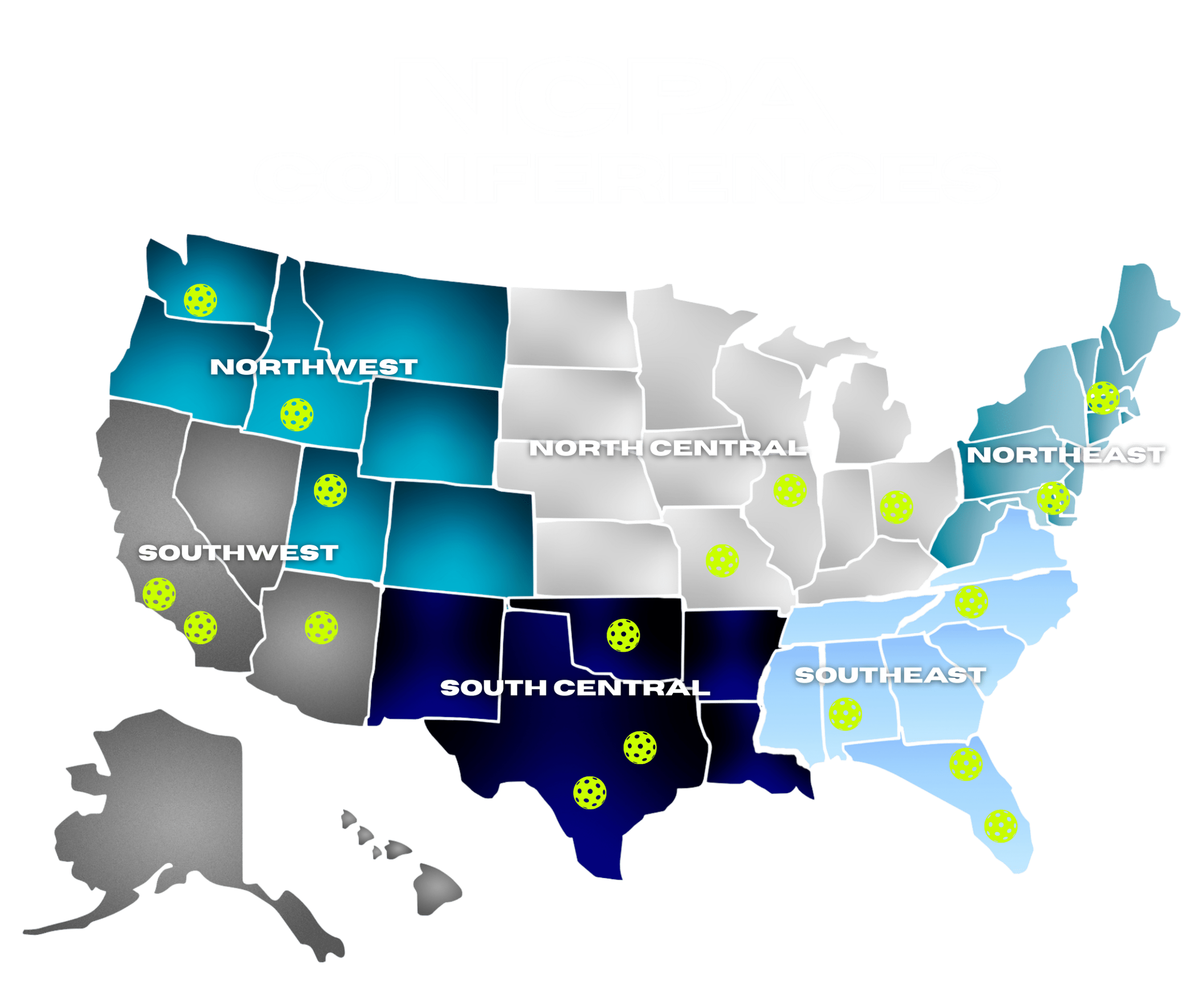
- West (SW + NW)
- Central (SC + NC)
- East (SE + NE)
Each team plays every opponent in their pool.
Results from pool play determine re-seeding for single elimination.
Single Elimination
Teams are seeded into three separate single elimination brackets.
Advancing teams are re-seeded 1–12.
The top 4 seeds receive a bye into the quarterfinals.
Final Bracket
The Quarterfinals, Semifinals, and Finals determine the overall Conference Champion.
Divisions 2 & 3 (D2 & D3)
- Individual and challenger brackets running all weekend
- Functions exactly like Regionals and Nationals
Scoring and Placement
- Captains record all scores on NCPA Software
- Player ratings, university rankings, and standings automatically update
Promotion & Relegation (Coming 2026)
- Top schools from each regional conference advance to the elite conferences the following year (PAC-12, BIG 12, ATL-12)
- Bottom-performing elite programs are relegated back to regional play